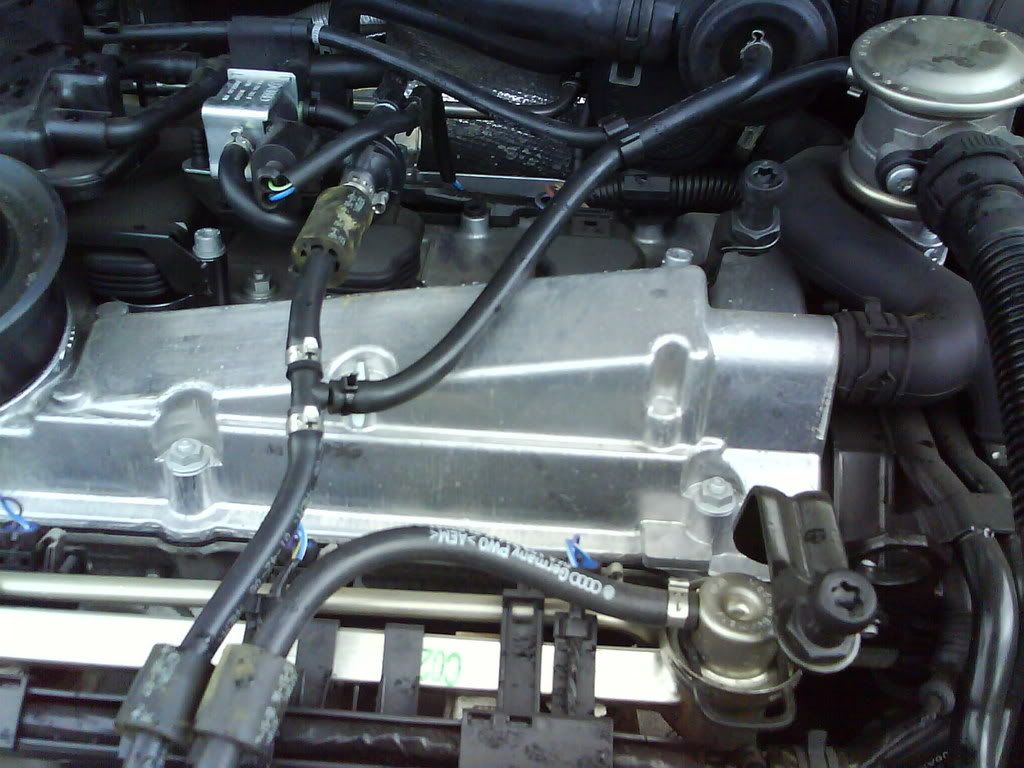
Rich_T wrote:good job whitepolo,
wished i had half a clue what it all meant.... lol

glad your happy with your remap

hope this expalins it to you
N249 is controlling the DV (Dump Valve). It is installed between the intake vacuum source and DV itself. When no current is switched to the N249 (default state), the DV will get vacuum or boost from the intake manifold. This is how almost ALL turbo cars are worknig. When shifting gears, you let off throttle, TB closes and vacuum is generated which can open DV to vent boost (which cannot enter engine, because TB is closed).
On never 1.8Ts (2000+) they introduced the N249 (along with lots of other stuff) which is a possibility for the ECU to open the DV any time (!), even during full throttle/acceleration. When the engine is running and turbo is boosting, there is no vacuum generated, but to open the DV (which is mechanical), vacuum is needed. This is what the black vacuum reservior on top of the engine is used for. When idling, shifting, etc - so when vacuum is available, vacuum is led into this reservoir from the intake manifold and kept inside using a check valve (white/black), so when boosting again, vacuum will stay there (air cannot enter into the reservoir).
When ECU wants to open DV durnig full throttle/acceleration, simply "energizes" N249, which will "de-select" the DV from the intake manifold (boost), and "switches" it onto the vacuum reservior. The vacuum in the reservoir will open the DV instantly and release your boost, which, in most of the cases (tuning, etc) is not that highly required . In the case ECU sees a little overboost problem, it can turn N249 on/off repeatedly for very fast (just as N75 is working), which will open/close DV all the time, trying to settle (lower) the boost level.
PROs: By removing N249 valve, you can prevent this bad habit of the ECU, and by removing N249 valve, you are removing an approximately 2mm narrow bottle neck restriction (ID of the N249 valve) in the line to the DV, which will result in a somewhat faster DV response. I am using the stock bosch DV, but it feels just as good as an aftermarket DV with N249 (restriction) inline. Boost curve is smooth and progressive.
CONs: Boost overshots/spikes may grow higher, especially in high gear/low rpm situations (using the small K03), which can result in a leaner condition (for the moment). These spikes depend on N75 type, wastegate setting and software programming, but they usually don't last long (0.5-1s max). In the case these spikes are very high (car enters limp even), minor adjustment on the wastegate can be done. .
 highly recommended!